Service Dog Tasks and the Public Access Test, Explained
This page explains the law in general terms. It is not legal advice. For a specific situation, contact the agency listed on this site or an attorney.
Two ideas come up again and again when people train a service dog: the tasks the dog performs, and the public access test. They are related, but they are not the same thing. Tasks are what make a dog a service animal. The public access test is a way to check that the dog behaves well in public.
This guide shows you how to identify a true task, build one with reward-based methods, and use the public access test as a training benchmark. It also covers what the law in Delaware and under the ADA does and does not require.
The short answer: what tasks can a service dog do?
ADA.gov defines a service animal as a dog individually trained to do work or perform tasks for an individual with a disability. The key words are "individually trained" and "work or tasks." The task has to be directly related to the person's disability.
So the question "what tasks can a service dog do" has a wide answer. A dog can be trained to do many things, as long as the work is tied to the handler's disability and the dog performs it on cue or in response to a specific trigger.
Delaware's Equal Accommodations Law uses a similar definition. The Delaware Code, Title 6, section 4502, defines a service animal as a dog individually trained to do work or perform tasks for the benefit of a person with a disability, including psychiatric, intellectual or other mental disabilities. It names dogs only.
Examples of service dog tasks by disability
The examples below are common ways trained dogs help. They are illustrations, not a complete or official list. Each dog's tasks are decided by the handler's needs.
Mobility and physical disabilities
- Retrieving dropped items such as keys, a phone or medication
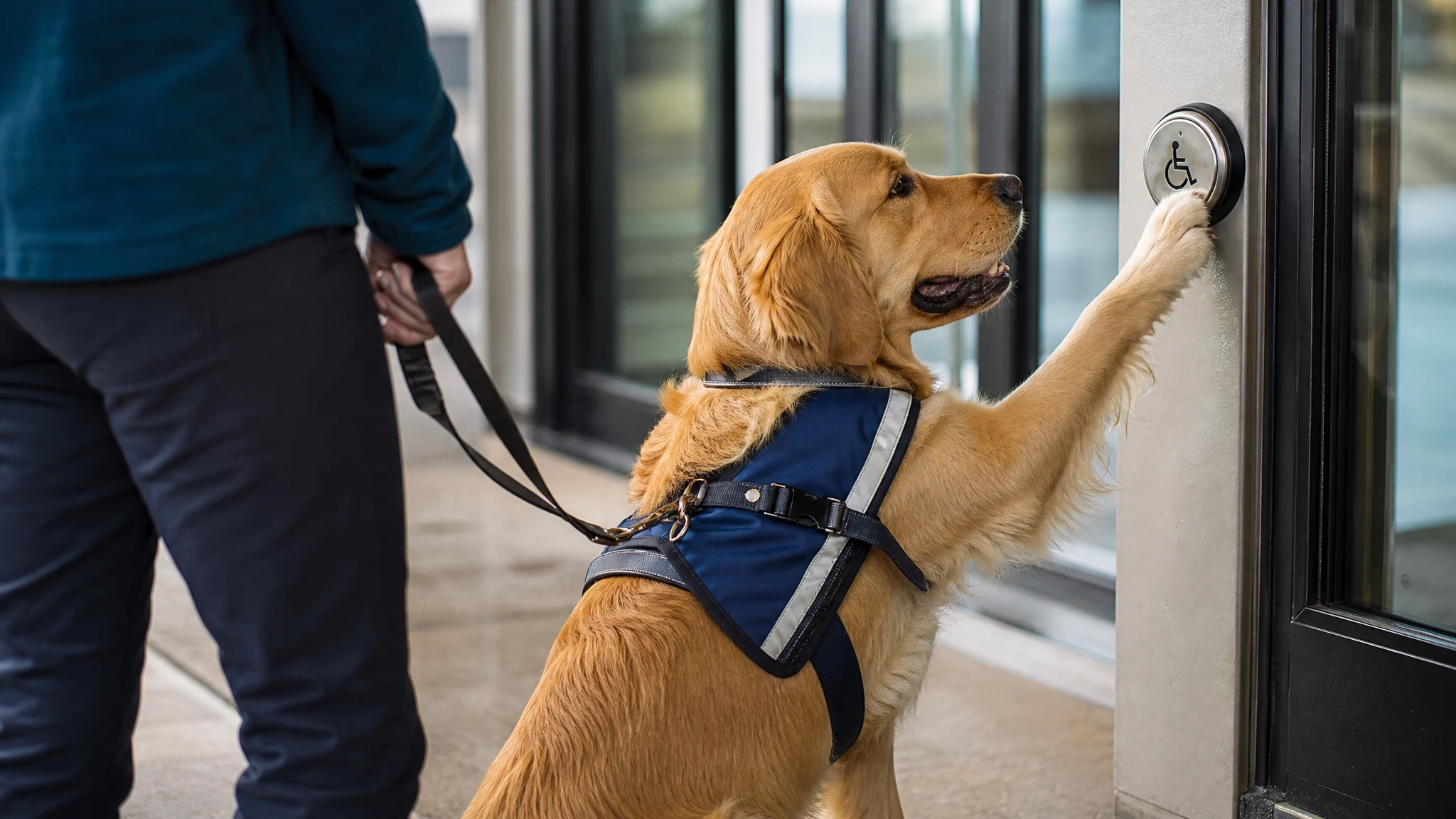
- Opening and closing doors or drawers with a tug strap
- Turning light switches on and off
- Providing counterbalance or bracing while the handler stands up, if the dog is suited to it and a medical professional agrees
Hearing loss
- Alerting the handler to a doorbell, smoke alarm or a name being called
- Leading the handler to the source of a sound
Vision loss
- Guiding around obstacles, stopping at curbs and stairs
- Finding doors, crossings or elevators on cue
Diabetes, seizures and other medical conditions
- Alerting to a change the dog has been trained to detect, then taking a specific action such as nudging or fetching a kit
- Staying with a handler during a seizure and, if trained, activating an alarm or fetching help
- Fetching medication or a phone
PTSD and psychiatric disabilities
- Interrupting repetitive or self-harming behavior with a trained nudge or paw touch
- Turning on lights and checking a room on cue
- Creating space by standing or positioning beside the handler in crowds, on cue
- Waking the handler from a nightmare with a trained response
- Reminding the handler to take medication at set times
Autism and other developmental disabilities
- Interrupting a trained pattern of behavior such as a harmful repetitive action
- Blocking or guiding the handler away from a hazard such as a road
- Staying tethered and steady to help prevent bolting, where the handler's team has planned for this
Why comfort alone is not a task
ADA.gov is clear that the work or task must be something the dog is trained to do. A dog whose presence soothes its owner is doing something kind, but under the ADA it is not performing a task related to a disability.
Emotional support, therapy and comfort animals are not service animals under the ADA. That is true even when the animal helps a great deal. It is the individual training to perform a specific, disability-related action that makes the difference.
A useful test is to ask whether the dog does something on cue or in response to a trigger that you could describe in a sentence. "Presses against my legs and applies deep pressure when I start to panic" is a described task. "Makes me feel better by being near me" is comfort.
The public access test is a benchmark, not a legal requirement
The public access test is a standard used in assistance dog training. Assistance Dogs International (ADI) uses a public access standard as part of how its member programs evaluate dogs and handlers. Many trainers and owner-trainers borrow the idea to measure their own progress.
It is not an ADA requirement. ADA.gov states that when it is not obvious, staff may ask only two questions: whether the dog is a service animal required because of a disability, and what work or task the dog has been trained to perform. Staff cannot demand that a dog pass a test as a condition of entry.
A business may still ask a handler to remove a dog that is out of control or not housebroken. Good public manners are part of what keeps access smooth, which is why the benchmark is worth training toward.
There is also no official service dog registry or required certification under the ADA. You do not need to register or certify your dog, and an online registration or ID card is not legal proof of anything. Do not pay for one thinking it is required.
How to train a task and prepare for a public access test
Materials you will need
- A flat buckle collar or a front-clip or back-clip harness that fits well
- A standard six-foot leash
- Small, soft, high-value treats and a treat pouch
- A clicker or a consistent marker word such as "yes"
- A mat or small blanket for settle practice
- Props for your specific tasks, such as a tug strap, a retrieval item or a light switch target
- A training log, paper or digital, to record sessions and progress
- A training plan, ideally built with a qualified, reward-based trainer
Step 1: Write down the disability-related need
Start with the problem the dog will help with. Write each task as a clear sentence: the trigger, the dog's action and the result for you. For example: "When I drop an item, the dog picks it up and places it in my hand."
If you cannot connect the action to your disability, it is probably comfort rather than a task. A medical or rehabilitation professional can help you decide which tasks make sense for your situation.
Step 2: Build a strong foundation
Before any task work, teach the basics: sit, down, stay, come, loose-leash walking and a reliable settle on a mat. Reward every correct response with a treat, praise or play. The American Veterinary Society of Animal Behavior (AVSAB) supports reward-based methods, and that is the approach to use here. Avoid shock, prong or choke collars, and avoid dominance methods such as alpha rolls or scruffing. They are linked to fear and stress, which work against the calm, confident dog you need.
Step 3: Teach each task in small pieces
Break the task into tiny steps and mark and reward each one. To teach a retrieve, for example, first reward the dog for looking at the object, then for touching it, then for picking it up, then for holding it, and finally for bringing it to you.
Keep sessions short, about five minutes, and end on a success. Add the cue only once the dog performs the behavior reliably.
Step 4: Add a trigger and make the task reliable
Once the dog knows the action on cue, connect it to the real trigger. For an alert task, this means pairing the action with the sound, scent or behavior you want the dog to respond to. Practice in many rooms and positions so the dog does not tie the task to one spot.
Step 5: Proof in public, gradually
Move practice from home to quiet outdoor areas, then to busier places. Increase distraction a little at a time. If the dog cannot take a treat or follow a cue, the setting is too hard, so move back a level.
In Delaware, the Equal Accommodations Law at 6 Del. C. section 4504(a)(3) also requires public accommodations to permit an individual training a service animal, accompanied by the animal. The text does not state an age, harness or ID condition, and it does not say whether it applies only to professional trainers. If you plan to train in public, check with the Delaware Division of Human and Civil Rights about how it applies to you.
Step 6: Practice the public access test skills
Public access benchmarks typically look at the dog's control and manners in real settings. Skills commonly practiced include:
- Walking calmly on a loose leash through crowds and doorways
- Ignoring food on the floor and strangers who try to pet or call the dog
- Settling under a table or beside a chair for an extended time
- Staying composed around noise, carts, elevators and other animals
- Eliminating only on cue or in appropriate places
- Staying quiet, without barking or whining, unless trained to alert
- Responding to cues the first time around distractions
The exact items, scoring and format are set by ADI and by individual programs. Check with ADI or the program you are working with for the current criteria rather than relying on a summary.
Step 7: Run a mock test and record the results
Ask a friend to help. Walk a route through a store or public building and note where the dog slips. Record each session in your log, then return to the skill that needs work in a quieter setting. Repeat until the dog is steady across several locations and times of day.
Tips for better training sessions
- Train when the dog is rested and neither starving nor stuffed.
- Keep treats small and varied so the dog stays interested.
- Practice the same task in several places, not just one.
- Watch the dog's body language. Yawning, lip licking or avoiding eye contact can signal stress, so slow down.
- Take breaks. Both of you learn more in short, frequent sessions.
- Build the dog's confidence in new places before asking for hard tasks.
Common mistakes to avoid
- Counting comfort as a task. A calming presence is valuable, but it does not meet the ADA definition.
- Paying for a certificate or registration. The ADA does not require one, and it does not prove your dog's status.
- Treating the public access test as a legal gate. It is a training benchmark, not a rule under the ADA.
- Skipping the foundation. Rushing into public work with a dog that cannot settle usually creates setbacks.
- Using harsh tools or corrections. These can damage trust and work against reliable, calm behavior.
- Training in places that are too hard, too soon. Build up gradually.
- Assuming all dogs are suited to the work. Some dogs are not temperamentally right for public work, and that is a valid outcome.
What to expect
Results vary with the dog's temperament, the complexity of the task and how consistently you practice. Many handlers find that simple tasks can take weeks to become reliable, while complex or scent-based tasks may take many months or longer. Progress is rarely a straight line.
With steady, reward-based practice, a dog may become more focused and composed in public, and tasks may become more dependable. Some dogs may still be better suited to other roles. No training plan can promise a particular outcome, so check in regularly with a qualified, reward-based trainer.
Your rights and where to turn
Under Delaware's Equal Accommodations Law, a place of public accommodation must permit an individual with a disability accompanied by a service animal. Guide dog users also have access rights under the Delaware White Cane Law, 16 Del. C. chapter 95. For a fuller look at access and training rules, see our guide to service dogs in Delaware, including training and access rights.
I could not find a Delaware law that sets a specific penalty for misrepresenting a pet as a service dog. If you have questions about that, check with the Delaware Division of Human and Civil Rights.
If you believe you were refused access, the Delaware Division of Human and Civil Rights takes Equal Accommodations complaints through an online form. The deadline is 180 days from the incident, so do not wait. This is a summary of the law, not legal advice.